Vote for Your Climate Future 2050
The Canadian federal electoral landscape has changed dramatically leading into the upcoming COP21 UN Climate Conference in Paris. There is now the potential to galvanize climate action at all levels of Canadian society. Edmonton Mayor Don Iveson noted, “[b]ig cities have taken a leadership role by implementing practical environmental initiatives. . .We need other governments around the world to make similar commitments towards increasing energy efficiency, reducing reliance on non-renewable energy, and thereby reducing our greenhouse gas footprint.” (July 2015 Big City Mayors’ Caucus). The time is ripe for the federal government to step up and stimulate ‘changes’ to move Canada towards a low-carbon economy and sustainable society; however, this begs the question,
On October 30th, 10:00 am-12:00 pm PST or 1:00 pm- 3:00 pm EST, a diverse group of scholars from the Sustainable Canada Dialogues project met to discuss what, how wide and how deep do we need to go to successfully mitigate and adapt to climate change. The panelists included
Moderator, School of Environment & Sustainability, Royal Roads University
Department of Biology, McGill University, Trottier Fellow from the Trottier Institute for Science and Public Policy Director, Panama Field Study Semester
Department of Physics, Université de Montréal
Associate Provost, Sustainability, University of British Columbia, Professor, Institute for Resources, Environment and Sustainability and Department of Geography, University of British Columbia
Urban Studies and Geography, Simon Fraser University
Department of Zoology, University of British Columbia
Department of Political Science, Simon Fraser University
Postdoctoral Fellow, Department of Geography, University of Victoria
Three Possible Climate Scenarios for Canada
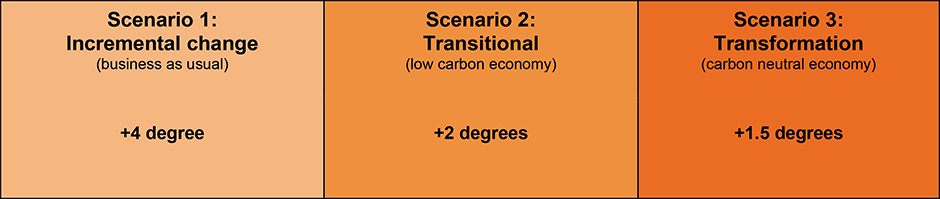
We have prepared three scenarios that depict likely outcomes from three different development pathways, based on a change continuum now being explored by the MC3: Meeting the Climate Change Challenge research team.
Incremental
Small steps towards climate change adaptation that are ‘politically safe’, that do not change existing natural resource development and that do not question the current socio-political arrangements and infrastructure (i.e. energy efficiency).
Transitional
Large actions that require bold technological and social innovation supported by significant government leadership and incentivization, with some reform of the dominant socio-political arrangements and major reform of infrastructure (i.e. district energy systems, decentralization of the grid).
Transformational
A fundamental shift in the socio-political regime and governance underpinned by a carbon neutral economy.
Click on the 2050 scenarios below to expand the table and explore three alternative future development paths for your country.
Resources and References
Black, R., Adger, W. N., Arnell, N., Dercon, S., Geddes, A., & Thomas, D. S. G. (2011). Migration and global environmental change: Future scenarios. London, UK. Retrieved from http://centaur.reading.ac.uk/27073/
Torrie, R. (2013). An 80% Carbon Reduction: It’s Not Just Business as Usual. Trottier Energy Futures Project. Retrieved from http://www.trottierenergyfutures.ca/an-80-carbon-reduction-its-not-just-business-as-usual